BAREFOOT COMMUNICATORS
A friend researching the history of filmstrips unearthed a treasure for me. In 1974 the legendary Anil Agarwal who went on to found the Centre for Science and Environment (now led by Sunita Narain) used to write for Hindustan Times under the pseudonym “Square”.
Anand Patwardhan was then working in a rural education and farming project called Kishore Bharati and had made a filmstrip. Anil saw and reviewed it titled “Barefoot Communicators“.
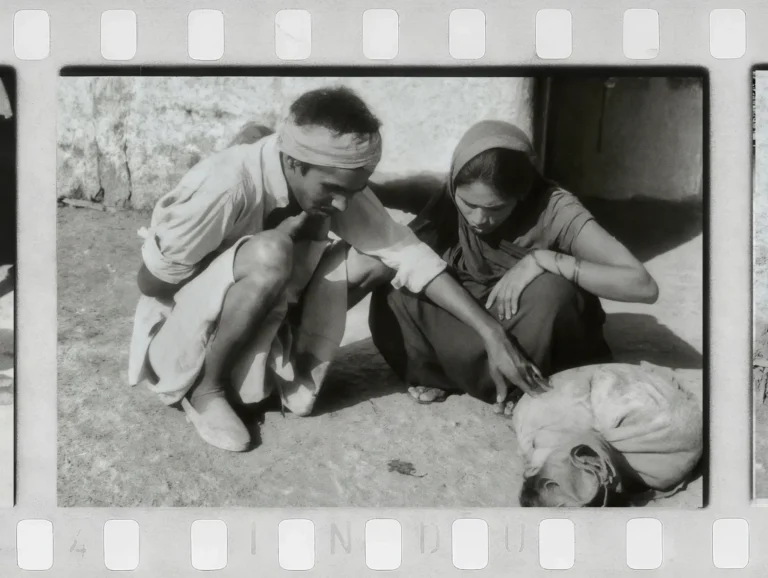
SQUARE was at Kanpur last week to attend a symposium on educational film organised by the TV centre of the local IIT. He was sceptical about the role of such costly and sophisticated thingamies like films and projectors.
But the half hour he spent watching Anand Patwardhan’s little effort to educate the villager about the dire consequences of TB convinced him that there is far more to the medium than he had anticipated. Even the experts were all in praise for Patwardhan.
Anand Patwardhan is a young volunteer with Kishore Bharati, a rural service organisation working in Hoshangabad. With the help of the Indian Institute of Mass Communications, New Delhi, he has made a film strip which costs less than Rs 200. A conventional film of the same length could have cost as much as Rs 5000. All that Patwardhan did was to write down a script, take a series of shots with a box camera, and put his commentary and dialogues into a cassette tape recorder. He then taped his black and white transparencies into a sequence according to the script and his film strip was ready. While the recorder played back the commentary, Patwardhan slowly pulled the strip across the light of the projector — all so well done that not for a moment did Square feel he was only watching stills.
The “hero” of the film strip is a farm labourer, Gurdayal, who finds one day that he is coughing blood. His family forces him to consult a doctor some ten miles away. Gurdayal trudges along to the clinic and on the way meets a sick fellow, Hari Prasad, whose body has completely wasted away. The doctor tells Gurdayal that he has T.B. and that he will have to take care and nurse himself to total recovery if he does not want to die. Gurdayal says he lives too far to come every week for an injection, and the doctor tells him to eat nutritious food. But on the doctor’s advice, he promises to grow vegetables in his backyard.
As time passes, he recovers and begins to smoke again. But when he remembers Hari Prasad, whom the doctor had introduced to him as one who had been lax about his care, he stops smoking. Gurdayal slowly recovers and happily takes his entire family to the doctor to get them vaccinated with BCG.
Almost all of Patwardhan’s village audiences have reacted favorably to his film strip. They remember most of all the flashback to Hari Prasad. “We should stop smoking,” several of them remarked after seeing the strip. Delhi slum-dwellers who were also shown the film strip liked it and said there was nothing in it that they could not understand. There is nothing arty about the film.
Praise for the film strip notwithstanding, one question remained unanswered at the symposium: “Did the villagers react favorably to the film strip because Patwardhan, a familiar sight amongst them, was screening it?”
This may be an important question. The Hoshangabad villagers know and trust Patwardhan. He is no city-sahib come to dupe them from goodness alone knows where.
Paul Lazarsfeld, a communication expert, strongly believes that interpersonal communication goes a long way to reinforce the influence of mass media. Supplementary face-to-face contacts produce a far greater “clinching effect” than do mass media working in a vacuum. Communist cadres in China, for instance, play a major role in reinforcing mass media messages. If this is so, Patwardhan’s plea for “barefoot communicators,” somewhat ignored at the symposium, may be worth serious examination.