Intro to Barefoot Gen
September 2004
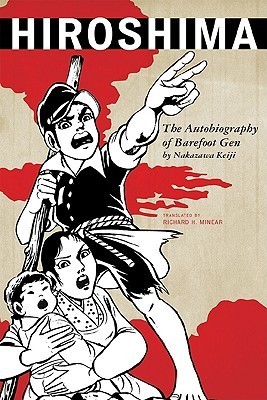
Barefoot Gen: An Introduction
The dismay we felt in May 1998 when India and Pakistan did nuclear tests had as much to do with the realization that the world had lurched closer than ever to destroying itself as it did with the horror of witnessing our countrymen celebrating in the streets at having acquired the capability for mass destruction.
As we, the handful of peace activists that knew better, went about the task of trying to talk people out of their euphoria, I realized how little people understood what a nuclear holocaust actually was. The best thing we could find were a few old black and white documentary films about the bombing of Hiroshima and Nagasaki. We set up screenings in schools and colleges and working-class neighbourhoods. After the screenings there was an immediate transformation. People recoiled from the images of carnage, and the pride of becoming a member of the atomic club was quickly replaced by fear and loathing. And yet there was something missing. The images of the dead and injured were still images of strangers in a faraway land. The fact that this could well be the fate of our own near and dear ones registered intellectually but not quite emotionally. What we needed was to see the people of Hiroshima and Nagasaki not so much as “victims of the A-bomb” but as human beings of flesh and blood as ourselves, people whom we could touch and feel.
It is this quality we appreciate most in the story of Barefoot Gen. A comic book aimed primarily at children, the book works wonderfully well for adults as well. There is of course pedagogy in it for there are few details missing in this tale about the tribulations of living in small town, war-torn Japan prior to the apocalypse that was caused by the first and only atom bombs to have ever been dropped on human beings on this planet. And yet as we begin to read we never once sense that we are being taught a lesson from a crucially important chapter in the history of the world – a chapter the world may forget at its own peril.
I used the word “comic” book because we have no other way to describe a story told in picture form but this is of course far from comedy although there are moments of humour interspersed with those of pain and deprivation as we take a close look at a family trying to survive the war. In many ways the book is like a Greek tragedy where everyone knows the ending and so the interest lies more in the details of how the story unfolds. Almost the entire book passes without its central theme being revealed. Only the last few pages speak of the moment when the A- bomb struck and describe the havoc that it instantly wreaked.
The story of what happened after the bomb fell is continued in a sequel but this first book, Barefoot Gen concerns itself with the tale of the Nakaokas, an agrarian family growing up in Hiroshima in the months and days before the Bomb. The young boy Gen and his siblings and parents survive by growing wheat on a small patch of land, and by doing other odd jobs. Food scarcity is acute and the children are forever hungry. Despite the all-pervasive, shrill propaganda of the Japanese Imperial Military, father Nakaoka has begun to realize that Japan is actually losing the war and this has made him question the war itself. But questioning the war is high treason at this point in time and the family begins to face political repression and social boycott.
Nakaoka’s anti-war views grow stronger by the minute but so does the price he pays for his views as he ends up in prison. Meanwhile the children also face the opprobrium of having a father who is a “traitor”. So much so that Gen’s elder brother defies his father’s pacifist wishes and enlists himself in the Japanese military in order to retrieve the family honour. The tragedy is compounded by the fact that the unit he joins is detailed for suicide missions. When the bomb falls on Hiroshima towards the end of the book Gen and his mother survive. She gives birth to a baby. Life continues. Gen will be our eyes and ears once again in the continuing story as we travel through the ruins of Hiroshima and Japan in the wake of an atomic holocaust.
Gen and the Nakaokas remain credible throughout the story because they are never painted as creatures of perfection. They too fall prey to the racism that Japanese generally expressed towards Koreans for instance, until a Korean neighbour comes to their rescue at a time of need. Even the brave and admirable father Nakaoka whose pacifist principles we can all applaud is far from perfect. He resorts, at the drop of a hat, to the corporal punishment of his own children. This is an obvious critique of the machismo inherent in traditional Japanese society but it is interesting that the author chose to include it in the present story as if to say, here are human beings in all their failings and their strengths. We may like some of the things they do and dislike other things just as we do with our own friends and relatives. It is this that makes the characters come alive for us and makes us identify with them.
If there is one thing I would criticize in Barefoot Gen it is the fact that while there is a scathing critique of Japanese militarism, machismo and myopia during the war, the USA emerges almost blameless in the story despite the fact that they are the ones who dropped the atom bombs. It is almost implied that the Japanese ruling elite had themselves to blame for the nuclear holocaust and that the Americans had no choice but to bring a swift end to the war by dropping atomic weapons. Recent research done after many documents were declassified in the USA suggests that the bombing of Hiroshima and Nagasaki was much less justifiable than earlier presumed. Japan’s military might had been already destroyed and secret wireless messages that were decoded by the Americans clearly indicated that the Japanese Emperor was willing to surrender if a deal could be worked out by which he could remain the nominal ruler of post war Japan. The Americans did agree to exactly such a deal but this was only after they had bombed Hiroshima and Nagasaki. Why then did they have to bomb? Research suggests that it may have had more to do with the beginnings of the Cold War between the USA and the USSR. The demonstration of the power of destruction that the USA now possessed was meant to keep its great emerging rival in awe. It was also to ensure that a Soviet invasion of Japan was made redundant and post-war Japan made dependent solely on the USA. There were also “scientific” reasons. The scientists wanted to gauge the varying destructive powers of two different nuclear devices – one based on plutonium and one on uranium. So we had Hiroshima and three days later, Nagasaki. It is true that these facts were not public knowledge back in 1972 when Barefoot Gen first came out and so it is understandable that they find no mention. But a little more scepticism of the American point of view would have been appropriate in any case.
Be that as it may, Barefoot Gen stands out for its deep humanity, its attention to sociological and historic detail, and its great accessibility to both children and adults everywhere in the world. The story of Hiroshima needed to be told and it needed to be told in an unforgettable manner. Barefoot Gen does just that.
Anand Patwardhan
September, 2004